
One bus for the whole home and the whole building
KNX is the only open international standard for residential and building control (ISO/IEC 14543). Every KNX-certified product we supply comes through the original channel, and the products interoperate with each other — no single-brand lock-in. Choose brands by budget at the start and mix freely later; the system does not become obsolete.
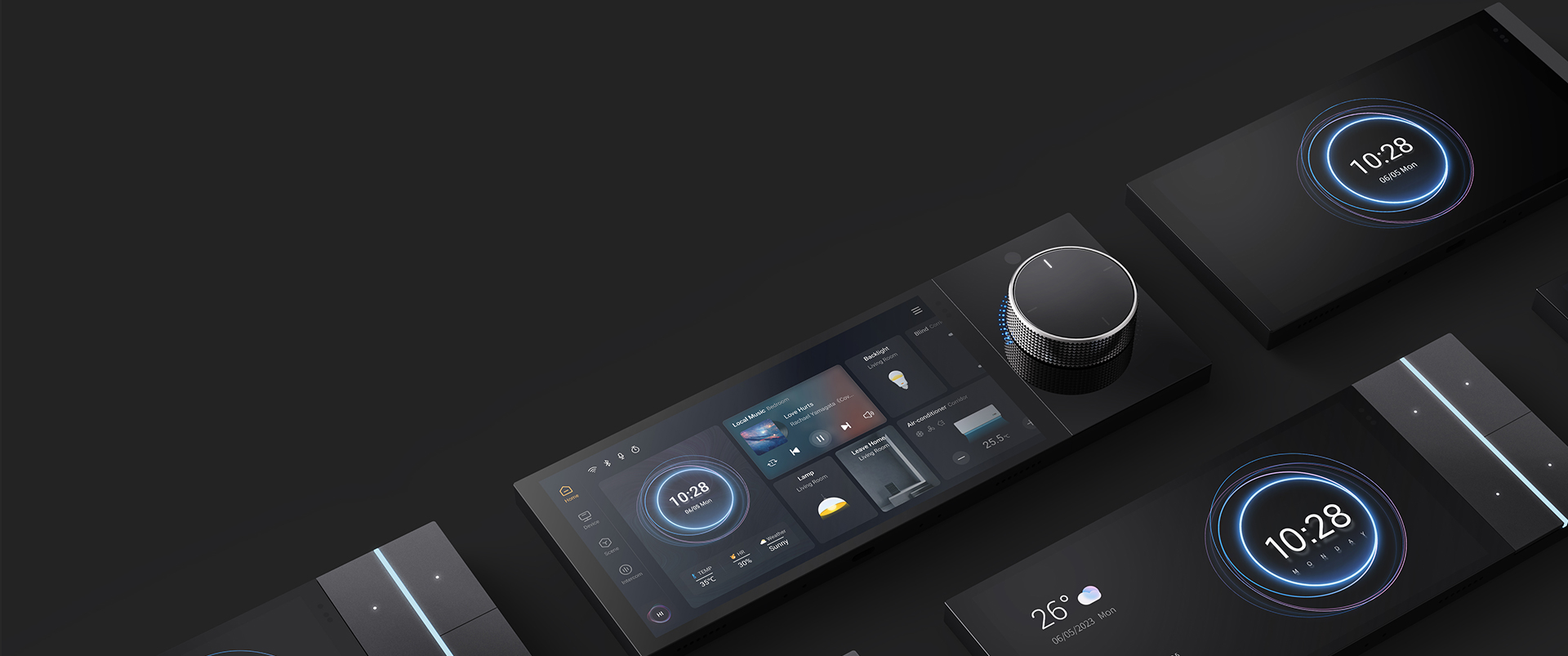
Brand support: the primary product line is the GVS Smart K-BUS (KNX) control system, covering Smart Touch panels, TFT LCD panels, sensors, actuators, input modules, protocol gateways, system devices and the software platform. Yihua Intelligent is an authorised GVS Smart distributor and also provides ETS configuration, programming, debugging and warranty support.
All supplied products are genuine KNX-certified items; serial numbers can be checked on the KNX website.
KNX Products from different brands work together on the same bus, so extension is never a problem.
We provide ETS configuration, programming and commissioning, and can also deliver alongside third-party contractors.
The GVS K-BUS product system
Supplied along GVS's own product line, from panels through to the software platform.
Smart Touch panels and TFT LCD Panel
KNX Smart Touch S15, S13, S10 and S7, C40 and C40 Pro smart panels, scene, switching (one, two and three gang) and curtain panels, with Customization Laser Engraving available.
Input devices and sensors
Presence detection, illuminance, temperature and humidity, and wind and rain sensors, driving automatic scene triggers.
Actuators
Switching, dimming, curtain and fan coil actuators, DIN-rail mounted, in 4, 8 and 12 channel versions.
Gateways and system equipment
KNX/IP gateways, USB and serial interfaces, power supplies and couplers, bridging the bus to the local network and to third-party systems.
Software platform
Visualisation software and an energy dashboard, managing device status, scenes and reporting on one screen.
Nurse call
Nurse call, infusion monitoring, bedside interaction, care whiteboards and ward access control for hospital environments.
K-SMART wireless
Wireless smart screens and panels with serial and TFT display products, suited to retrofits and lighter projects.
Video Intercom
Outdoor Station SO801, Mini Outdoor Station SO001 and 10 inch Monitor SIA02, linked to unlocking and security.
How to choose between KNX, RS-485, power-line carrier and Zigbee
Put the common control methods side by side and the boundaries of each become clear. Which one to use depends on the project type, the budget and who maintains it afterwards.
| Comparison | KNX | RS-485 | PLC power-line carrier | Zigbee |
|---|---|---|---|---|
| What it fundamentally is | A complete international building control standard — protocol, physical layer and application layer | An electrical and physical layer standard only; the application layer is defined by each manufacturer | A communication technology that carries data over existing mains wiring | A low-power wireless mesh network standard |
| Standard and openness | ISO/IEC 14543 and GB/T 20965, with multi-brand products recognised and interoperable | Electrical layer is common; protocols are proprietary by vendor (such as Modbus) | Mostly proprietary vendor schemes (for example the Huawei PLC-IoT ecosystem) | Based on IEEE 802.15.4, a unified standard |
| Cabling and construction | Dedicated twisted-pair bus, may share conduit with mains, needs professional tools for commissioning | Needs its own cabling; low material and labour cost | No new cabling needed, so it wins on retrofit projects | No wiring; battery-powered devices are possible |
| Stability and reliability | High: wired transmission with telegram acknowledgement and retry, suited to long-term operation | High: wired and resistant to interference, but the whole system depends on master polling | Affected by grid noise and phase differences, so results vary | Moderate: 2.4 GHz is easily interfered with and attenuation through walls is significant |
| Interoperability | Strong: different brands can be mixed and the system is not locked to one manufacturer | Weak: changing brand usually means rebuilding the system | Weak: different schemes are essentially incompatible with each other | Moderate: the protocol is unified, but ecosystems still differ |
| Extension and scale | Structured line, area and domain topology, extensible to tens of thousands of points | Limited by bus load and the capacity of the master controller | Node count limited by coupling and the condition of the grid | Limited by routing depth and channel capacity |
| Typical scenarios | Hotels, offices, public buildings, whole house villas, airports and rail transit | Instrumentation, access control, simple centralised control | Light retrofit of finished homes; PLC-IoT home backbone schemes such as Huawei whole house intelligence | Light home lighting, sensor networking |
| Main limitation | Higher cost and a higher commissioning threshold than RS-485; needs the professional ETS tool | No unified application layer protocol, making later extension and operation difficult | Stability depends on the condition of the site grid | Needs care in critical locations and large-scale systems |
| Representative brands | ABB, Schneider Electric, Siemens, GIRA, JUNG, HAGER, MDT, Zennio, Theben, GVS Smart and more than 500 KNX member manufacturers worldwide (this site is an authorised distributor for GVS Smart) | Mostly vendor-proprietary buses with no unified brand alliance; for example Hikvision and Dahua PTZ control (Pelco protocol) and the Modbus instrumentation ecosystem | Power sector: State Grid smart meter HPLC schemes (Huawei HiSilicon is the main chip supplier); smart home: Huawei whole house intelligence uses PLC-IoT as the home backbone (earlier schemes such as X10 have faded) | Aqara, Philips Hue, IKEA, Samsung SmartThings, Tuya Smart and Xiaomi Mijia (some products) |
Note: PLC here means power-line communication, the carrier technique that sends control signals over existing mains wiring. If you mean the programmable logic controller used in industrial automation, that is a different concept entirely — it excels at logic and process control and is often used alongside building buses such as KNX rather than instead of them.
Note: the brands listed are illustrative of each technology route. The KNX column lists KNX Association member manufacturers (this site is an authorised distributor for GVS Smart). We hold no distribution relationship with the brands listed under the other routes, and the trademarks belong to their respective owners.
Which one fits your project
New builds and formal projects — prefer KNX
For hotels, offices, public buildings and villas that will operate for years, start with KNX. An open standard buys maintainability ten years out: parts are easy to source, engineers are easy to find, and changing brand does not mean starting again.
Budget-sensitive centralised control — RS-485 is possible
For projects needing only central switching, with few points and a tight budget, RS-485 is simple and cheap. But accept two things up front: the extension limits of a proprietary protocol, and the cost of changing manufacturer later.
Finished spaces with few points — wireless is simpler
When a finished room only needs a handful of extra points, Zigbee or power-line carrier avoids cabling and shows results quickly. If large-scale extension is likely later, still reserve the option of wired capacity, so the system does not end up split in two.
Tell us about your project
Send us the space, the function and the outcome you need. We reply with an approach, a system outline and a clear quotation.