
Three barriers hold most people back
You have heard the name KNX for years and seen it in tender documents, but the moment you have to run a bus project alone, three barriers remain. They do not go away on their own — the longer you wait, the more the opportunity goes to someone else.
Not confident quoting
When a client asks what a KNX scheme costs, the answer is evasive — circuits cannot be counted, equipment cannot be estimated, hours cannot be guaranteed. Without topology design ability, a quotation is a gamble: too high and you lose the job, too low and you lose money.
Cannot read the drawings
The design institute's bus topology diagrams and the consultant's point schedules are dense with lines and addresses, and there is no obvious place to start reading them. If you cannot get past the drawings, the door to large projects stays shut.
Never used the software
ETS is the engineering software shared by KNX engineers worldwide. A hundred explanations of the principles are worth less than one session at the keyboard — self-teaching from videos alone always stops at roughly understanding.
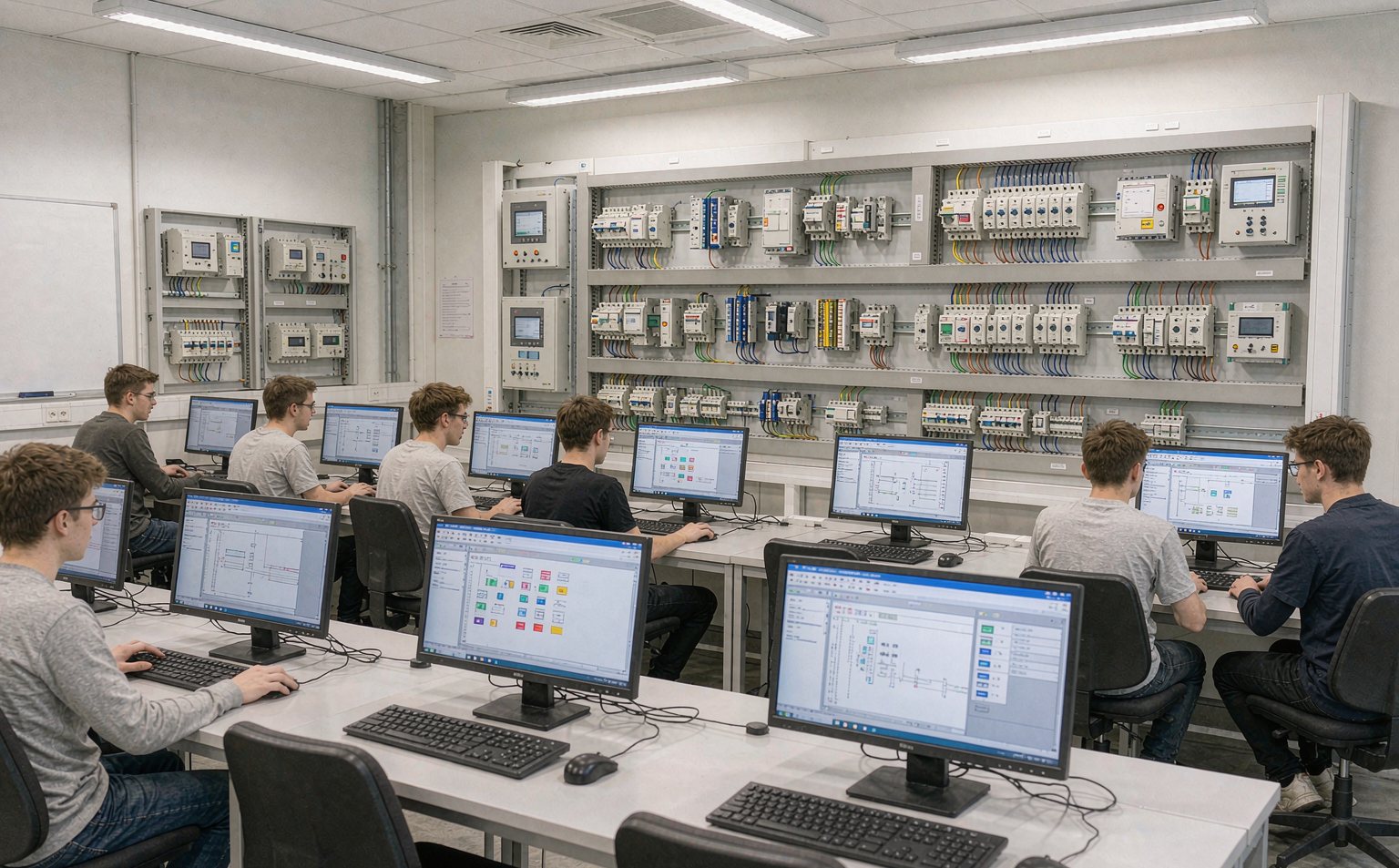
Starting from what a bus actually is
The course follows the KNX Association certification framework, covering the full loop from system design and programming through to fault diagnosis. On completing the course and passing the certification exam, you receive the international certificate issued by the KNX Association, which qualifies you to become a KNX Partner.
Bus structure, division into lines, areas and domains, and address planning.
Selection criteria and cabling essentials for power supplies, couplers, actuators and panels.
Hands-on programming of lighting switching and dimming, shading, and central functions.
Bus telegram analysis, locating common faults and system diagnostic methods.
Certification exam coaching at the end of the course, focused on passing the international KNX certificate.
Practical details
Length
Five days, 40 hours. Small classes taught in person, weighted towards hands-on work.
Who it suits
Wireless whole house integrators adding bus capability, engineers from ELV or electrical backgrounds, technical leads at smart building companies, and people changing careers.
What to bring
A laptop running Windows 10 or 11. Course hardware, devices and test boards are provided on site.
What you can do afterwards
Independently complete the design, programming and commissioning of a small to medium KNX project.
How the five days clear each barrier
Not a patchwork of disconnected topics but one complete path — principles, design, hands-on, practice, certification — with each day addressing one class of problem.
What you walk away with
Not just one more certificate, but a complete accumulation of capability, standing and professional contacts.
An international certificate
Issued by the KNX Association, recognised in more than 190 countries and verifiable on the official website. In a tender it adds technical marks; on a CV it is hard currency.
A reusable method
Reading drawings, measuring, quoting, programming, commissioning and delivering — the whole flow of a KNX project handled by hand once, ready to apply to the next job straight away.
A scarce position
Only a few thousand certified engineers exist in China. In the context of high-end projects the certificate speaks for itself — the client does not need to verify your ability.
A network of peers
Classmates come from whole house installation, hotels and building operations, and their project experience lights up in discussion — this peer network often outlasts the certificate.
Tell us about your project
Send us the space, the function and the outcome you need. We reply with an approach, a system outline and a clear quotation.